Enterprise LLMOps Platforms: Top 7 in July 2026
Most teams building AI systems hit the same wall eventually. You get the model working in development, you run some evals, everything looks fine. Then you ship it, and three weeks later you're debugging a hallucination that made it to a customer, or you're explaining to legal why you don't have an audit trail for a decision the model made last month. Traditional MLOps tooling wasn't designed to catch LLM-specific failure modes like toxicity, groundedness drift, or demographic bias. Enterprise LLMOps platforms are built to handle exactly that: behavioral evaluation before deployment, runtime enforcement once you're live, and compliance evidence generation that maps directly to frameworks like the EU AI Act. The seven platforms in this ranking differ sharply in how much of that loop they actually close.
TLDR:
- LLMOps covers behavioral evaluation, drift detection, and compliance mapping: tooling traditional CI/CD pipelines don't handle.
- Most platforms cover either evaluation or observability, but not runtime enforcement or automated compliance documentation.
- Openlayer blocks unsafe outputs at the API boundary and generates audit-ready records mapped to EU AI Act requirements.
- Braintrust, Langfuse, LangSmith, MLflow, and Arize AI log and surface data but don't enforce policies in production.
- Implementation timelines run four to twelve weeks for procurement, plus one to three months for full CI/CD integration.
What is an Enterprise LLMOps Platform?
LLMOps is the practice of running AI systems reliably in production at scale. Traditional MLOps assumes deterministic behavior: the same input returns the same output, and failures surface as catchable exceptions. AI systems don't follow that contract. The same prompt can return different outputs across runs, a grounded response in one instance and a hallucination in another, with no error thrown.
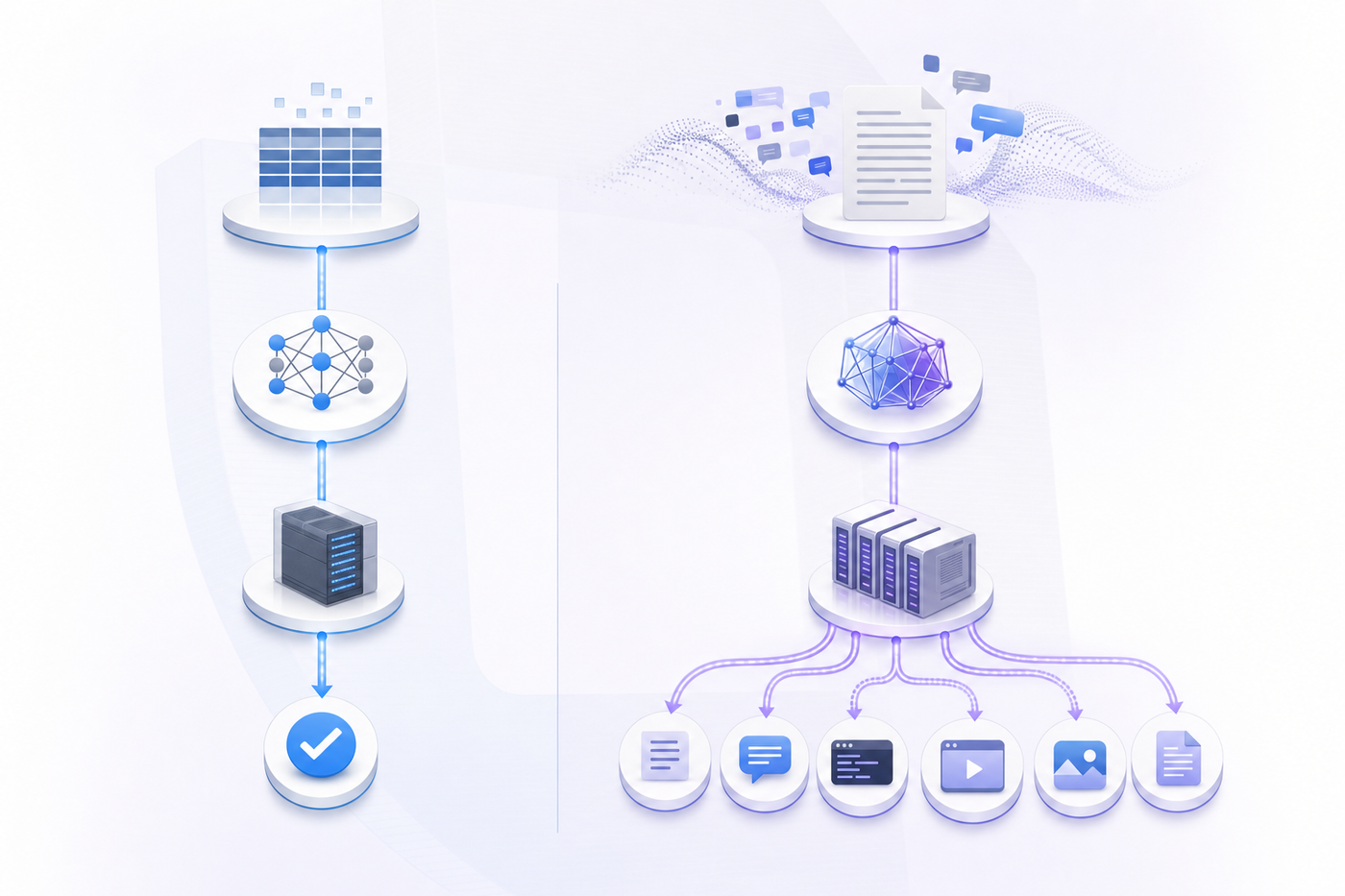
That gap is what makes LLMOps a distinct discipline. Enterprises deploying AI in regulated environments need tooling for behavioral evaluation, prompt and model versioning, drift detection, cost tracking across token-based inference, and compliance mapping to frameworks like the EU AI Act. A standard CI/CD pipeline was never designed to cover any of that.
How We Ranked Enterprise LLMOps Platforms
Each platform in this list was assessed across five criteria drawn from real enterprise procurement requirements.
- Evaluation depth: coverage of LLM-specific failure modes (hallucination, toxicity, groundedness, demographic parity) with pre-built and custom test support across both development and production.
- Observability and monitoring: real-time output tracking, drift detection, and the ability to trace failures back to specific inputs, model versions, or prompt changes after deployment.
- Governance and compliance: audit trail generation, policy enforcement at the API boundary, and mapped coverage of frameworks like the EU AI Act and NIST AI RMF.
- Enterprise readiness: SOC 2 compliance, role-based access control, self-hosting or data residency options, and SDK support across languages teams actually use.
- Integration footprint: compatibility with existing ML infrastructure, CI/CD pipelines, and LLM providers without requiring a full stack replacement.
No single tool scored at the top across all five. The rankings reflect where each tool's actual architecture delivers versus where it delegates to adjacent tooling or leaves gaps for teams to fill manually.
Best Overall Enterprise LLMOps Platform: Openlayer
Openlayer sits at the intersection of LLM evaluation, observability, and governance in a way that few enterprise tools do. Where most platforms pick one of those disciplines and build deeply, Openlayer covers the full lifecycle: from pre-deployment testing through production monitoring and compliance reporting, inside a single connected workflow.
That scope matters in enterprise contexts because the failure modes are distributed. A model that passes offline evals can still drift in production. A model that performs well on average can fail systematically on a protected demographic subgroup. Openlayer is built to catch both.
Evaluation and Testing
Openlayer ships with 100+ pre-built tests covering quality, safety, fairness, and groundedness. Teams can run these against model versions during CI/CD, compare outputs across prompt or model variants, and gate deployment on pass/fail thresholds before anything reaches production. The LLM-as-a-judge scoring layer runs at 81.3% human correlation, which gives automated evaluation enough fidelity to replace manual spot-checking at scale.
Production Observability
Once deployed, Openlayer tracks 13 session-level metrics in real time. When outputs drift outside defined thresholds, the system flags them automatically. Teams can set enforcement rules that block unsafe outputs before they exit the API boundary, instead of catching them in a post-hoc log review.
Compliance and Governance
Openlayer generates audit-ready documentation tied to each evaluation run: pass/fail records, metric scores, flagged failure modes, and model version hashes. These become the evidentiary record for frameworks like the EU AI Act, SOC 2, or internal governance review cycles. The compliance mapping is automated, not manual. For high-risk systems in particular, this satisfies Annex IV technical documentation requirements without manual reconstruction.
Integration Breadth
SDKs are available in Python, TypeScript, Java, and Go, which covers most enterprise engineering stacks without requiring a dedicated integration layer.
Limitations worth knowing: Openlayer is strongest when evaluation, monitoring, and governance are treated as connected problems. Teams that only need a lightweight experiment tracker or a standalone logging tool may find the full feature set more than their current workflow requires.
Best for: Enterprise ML and AI engineering teams that need evaluation, production monitoring, and compliance evidence generation in one connected system.
Most suitable for: Organizations operating under regulatory frameworks (EU AI Act, internal AI governance policies) where audit trails and behavioral enforcement are non-negotiable requirements, not nice-to-haves.
Braintrust
Braintrust is a developer-focused LLM evaluation and experimentation tool built around prompt versioning, dataset management, and scoring workflows. Teams use it to run structured experiments, compare model outputs across prompt variants, and log production traces for offline review.
Key Features
- Experiment tracking and prompt versioning for iterative development cycles
- Production trace logging for post-hoc analysis and offline debugging
- Dataset management and scoring pipelines for structured evaluation runs
Limitations
- No runtime guardrails or blocking enforcement in production
- No automated compliance mapping, audit trail generation, or governance reporting
- Coverage boundary stops at evaluation as an engineering workflow: outputs are logged for review, but there is no mechanism to block a non-compliant response before it leaves the API boundary
Best for: Engineering teams that need structured prompt experimentation and pre-deployment evaluation depth.
Most suitable for: Organizations where a separate governance layer handles compliance obligations and runtime enforcement sits outside the evaluation toolchain.
Langfuse
Langfuse is an open-source LLM observability and tracing tool built around visibility into LLM call chains, prompt versions, and token-level costs. Teams running complex pipelines often reach for it when they need detailed session traces and a self-hostable stack that keeps data within their own infrastructure.
Key Features
- Tracing with inputs, outputs, latency, and cost logged at each step of multi-turn or agentic pipelines
- Prompt versioning to track which prompt variant was active at any given inference
- Self-hosting option for teams that require data residency control
- Basic scoring and human annotation workflows for iterative development
Limitations
- Scope stops at observation: does not enforce behavioral thresholds, block unsafe outputs before they leave the API boundary, or generate audit-ready compliance records
- Runtime enforcement is delegated to third-party libraries like LLM Guard or NeMo Guardrails, requiring teams to wire together a separate enforcement layer
- Evaluation depth is shallow relative to enterprise governance requirements: lacks pre-built test suites at the scale needed for regulated deployment contexts
- No automated mapping from evaluation results to EU AI Act or NIST AI RMF obligations
- Self-hosting moves the infrastructure burden to the team, adding maintenance overhead that compounds as usage scales
Best for: Engineering teams that need detailed trace-level observability during development and are comfortable assembling a separate enforcement and compliance stack around it.
Most suitable for: Organizations with dedicated infrastructure capacity that can manage self-hosted deployments and integrate third-party enforcement tooling.
LangSmith
LangSmith is LangChain's observability and evaluation layer, built for teams already running LangChain-based pipelines. It covers the core LLMOps workflow: tracing LLM calls, running evals against prompt versions, and comparing outputs across experiments.
Key Features
- Tracing and logging across LLM chains and agents
- Prompt versioning and dataset management for iterative evaluation
- Experiment comparison across model and prompt configurations
- Human annotation workflows for labeling and feedback collection
Limitations
- Governance coverage is thin: logs and surfaces behavioral data but does not enforce output policies at runtime or generate audit-ready compliance records
- Platform skews toward LangChain workflows, which limits portability for teams using other orchestration frameworks
- Teams operating under EU AI Act obligations or internal risk review processes will need to layer additional tooling on top
Best for: Engineering teams already committed to the LangChain ecosystem who need solid tracing and eval tooling.
Most suitable for: Organizations where governance and runtime enforcement are handled separately.
MLflow
Key Features
- Experiment tracking and run comparison across model iterations
- Model registry with versioning and stage transitions
- Artifact logging for parameters, metrics, and model files
- Broad framework integrations including scikit-learn, PyTorch, and TensorFlow
Limitations
- Built for classical ML workflows: LLM evaluation, prompt versioning, and output quality tracking are not native capabilities
- No runtime guardrails or output enforcement
- No compliance documentation, audit trail generation, or governance tooling
- Production monitoring requires third-party integration
- Teams running LLM workloads typically bolt on additional tooling, which fragments observability across multiple systems
Best for: ML teams with mature classical ML workflows who need experiment tracking and model versioning.
Most suitable for: Organizations where LLM governance and production observability are handled by separate, dedicated tooling.
Arize AI
Arize AI is built around ML observability, with strong tooling for monitoring model performance in production. Its Phoenix product extends that into LLM tracing and evaluation, giving teams visibility into prompt/response chains, retrieval quality in RAG pipelines, and latency across inference calls.
Key Features
- Tracing and span-level visibility across LLM calls and RAG retrievals
- Embedding drift and data quality monitoring with configurable alert thresholds
- Experiment tracking and prompt versioning through Phoenix
- Integrations with major LLM providers and vector databases
Limitations
- Stays at the observability layer, surfaces what is happening in production but stops short of enforcing what should happen
- No built-in mechanism to block non-compliant outputs at the API boundary
- No automated compliance mapping to frameworks like the EU AI Act or NIST AI RMF
- No governance audit trail that satisfies enterprise procurement or regulatory review requirements
- Teams that need a full LLMOps loop spanning pre-deployment evaluation, production enforcement, and compliance documentation will need to assemble those capabilities from other tools alongside Arize
Best for: ML and LLM engineering teams that want deep production observability.
Most suitable for: Organizations that already have separate evaluation and governance tooling in place and are adding a monitoring layer on top.
Feature Comparison Table of Enterprise LLMOps Platforms
The seven tools covered in this list cover overlapping but distinct slices of the LLMOps stack. This table maps capability gaps side by side across the criteria that matter most in enterprise procurement.

| Feature | Openlayer | Braintrust | Langfuse | LangSmith | MLflow | Arize AI |
|---|---|---|---|---|---|---|
| Pre-built test library | Yes | No | No | No | No | No |
| Real-time guardrails (blocking) | Yes | No | No | No | No | No |
| CI/CD deployment gates | Yes | Yes | No | No | No | No |
| Automated compliance mapping | Yes | No | No | No | No | No |
| Framework-agnostic | Yes | Yes | Yes | No | Yes | Yes |
| Drift detection | Yes | No | No | No | No | Yes |
| Multi-agent evaluation | Yes | Yes | No | No | No | Yes |
| SOC 2 Type II | Yes | Yes | No | No | No | Yes |
| Air-gapped deployment | Yes | No | Yes | No | No | Yes |
The pattern holds across the board: most tools cover one or two columns well and defer the rest to adjacent tooling. Real-time blocking and automated compliance mapping are where the field thins out most sharply, and those two gaps carry the steepest consequences in regulated enterprise environments.
Why Openlayer is the Best Enterprise LLMOps Platform
Openlayer sits at the intersection of evaluation, observability, and governance across the full model lifecycle, from development through production. That scope matters in enterprise contexts, where the cost of a compliance gap or a silent model regression is measured in regulatory exposure and engineering rework alike.
Here is what separates Openlayer from the other tools in this list.
Evaluation that runs before and after deployment
Openlayer ships with 100+ pre-built tests covering hallucination, toxicity, groundedness, demographic parity, and more. Teams can run these as pre-deployment gates in CI/CD pipelines, blocking a model version from shipping if groundedness scores fall below a defined threshold, say 85%, or if a demographic parity gap exceeds 5%. The same evaluation suite stays active post-deployment, so regressions surface as soon as they appear in production traffic instead of waiting for a quarterly review.
The LLM-as-a-judge scoring layer reaches 81.3% correlation with human evaluators, which is the bar that makes automated quality scoring credible for enterprise sign-off and beyond engineering iteration.
Runtime enforcement beyond observation
Most tools in this comparison stop at detection. Openlayer's guardrails block unsafe outputs before they leave the API boundary. That is not monitoring with a manual follow-up step; it is active enforcement at inference time. For teams operating under EU AI Act obligations or internal content policies, that distinction separates a governance posture that survives an audit from one that only looks good in documentation.
Automated compliance mapping
Openlayer generates audit-ready evidence artifacts continuously, including pass/fail records, metric scores, and flagged failure modes, that map directly to EU AI Act technical documentation requirements and NIST AI RMF control evidence. Teams do not reconstruct compliance history after an audit request; the record is built as the model runs.
Breadth of integration
SDKs in Python, TypeScript, Java, and Go mean Openlayer fits into existing engineering workflows without requiring a stack rebuild. Agent evaluation covers 13 session-level metrics, including tool call accuracy, multi-turn coherence, and reasoning path validity, so teams running agentic workloads get the same governance coverage as teams running simpler inference pipelines.
Where Openlayer fits best
Openlayer is the right choice for enterprise teams that need evaluation, monitoring, and compliance evidence from a single system, particularly those operating under regulatory scrutiny, running agentic or multi-model architectures, or managing models across multiple deployment environments. Teams looking only for lightweight prompt logging or single-function eval tooling will find the governance depth here exceeds their immediate needs.
Final Thoughts on Enterprise LLMOps Infrastructure
The distinction between tooling that detects problems and tooling that prevents them from shipping is the line most enterprise buyers draw during procurement. A platform that logs unsafe outputs is useful for debugging; a platform that blocks them at the API boundary before they reach production is what keeps you out of incident reviews and regulatory filings. Most tools in this space pick one side of that line and stay there. If your architecture requires both, and you need compliance artifacts generated continuously instead of reconstructed after the fact, contact us and we'll walk through what that coverage looks like end to end.
FAQ
How do I choose the right LLMOps platform for my organization?
Start with four questions: Does your team need governance and compliance automation, or just development tooling? Are you subject to regulatory frameworks like the EU AI Act that require audit-ready evidence? Do you need runtime enforcement that blocks unsafe outputs, or only post-deployment logging? And does your stack require framework-agnostic integration, or are you already committed to a single orchestration layer like LangChain? The answers determine whether you need a unified platform like Openlayer or can assemble separate tools for evaluation, monitoring, and governance.
Which enterprise LLMOps platforms provide real-time blocking of unsafe outputs?
Only Openlayer in this comparison provides runtime guardrails that block non-compliant outputs before they leave the API boundary. The other platforms, Braintrust, Langfuse, LangSmith, MLflow, and Arize AI, stop at detection and logging. They surface problems after outputs have already reached production systems, which creates a liability window in regulated environments where blocked enforcement is required, not optional.
Can open-source LLMOps tools meet enterprise governance requirements?
Open-source tools like MLflow and Langfuse provide strong foundations for experiment tracking and observability, but they require substantial internal engineering work to add audit logging, role-based access controls, compliance mapping, and evidence generation. Teams with dedicated ML infrastructure engineers can bridge those gaps; teams without that capacity will find the maintenance overhead outweighs the licensing cost savings, particularly when audit deadlines compress timelines.
What's the difference between LLM evaluation platforms and LLM observability platforms?
Evaluation platforms test model behavior before deployment, running structured tests against prompt versions, model variants, and dataset samples during development. Observability platforms monitor outputs after deployment, tracking drift, latency, and behavioral failures in production traffic. Enterprise teams need both: pre-deployment gates that block non-compliant models from shipping, and continuous monitoring that flags regressions the moment they surface in live inference.
How long does enterprise LLMOps platform implementation typically take?
Plan for four to twelve weeks for evaluation and procurement alone at large organizations. Full integration with existing model registries, CI/CD pipelines, compliance workflows, and production monitoring infrastructure adds another one to three months, depending on how many legacy systems require custom connectors and how many internal approval gates the deployment plan must clear before production rollout begins.