Braintrust reviews, pricing, and alternatives (December 2025)
When you're comparing Braintrust pricing and features against other tools, you're really asking what evaluation, security, and governance look like in production. Braintrust covers the basics for prompt testing and version control. The question is whether that's enough for your deployment requirements, or if you need runtime protection, compliance automation, and continuous monitoring. Here's what each tool actually delivers beyond the marketing pages.
TLDR:
- Braintrust handles prompt testing and dataset evaluation but lacks runtime security guardrails
- Real-time blocking of prompt injection and PII leakage requires alternatives with enforcement
- Regulated enterprises need governance features beyond basic evaluation and trace logging
- Openlayer delivers unified testing, security, and compliance from development through production
What is Braintrust and how does It work?
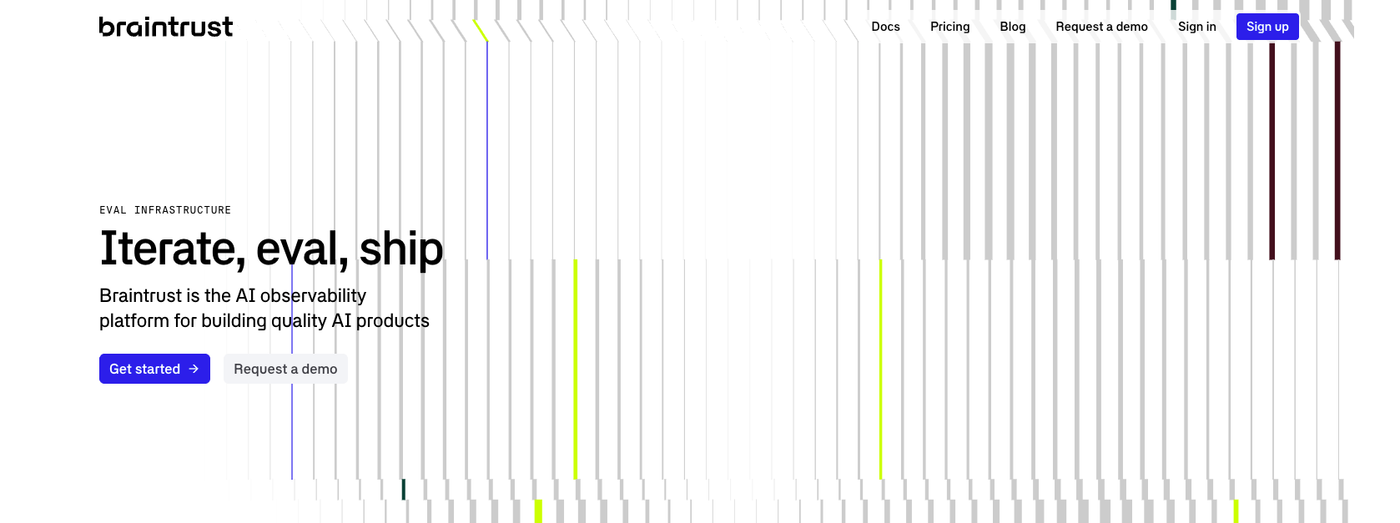
Braintrust is an evaluation and observability tool for AI applications built on LLMs. Teams use it to test prompt variations, track model outputs, and measure performance across versions. The tool runs automated evaluations against prompts and models using custom scoring functions. You define test cases in datasets, execute evaluations, and see how changes affect output quality. Braintrust supports custom evaluators written in code or pre-built scoring methods to measure accuracy and relevance. The system also includes a "prompt playground" which lets you experiment with different templates and parameters before deployment. You can compare responses side-by-side and iterate without pushing to production.
Braintrust integrates with CI/CD pipelines to run evaluations on every commit. The observability layer captures production traces, logging inputs and outputs to monitor live performance and debug post-deployment issues. All experiments and results are version-controlled for tracking changes between model iterations.
Why consider Braintrust alternatives?
Braintrust works well for teams focused on prompt-level evaluation and dataset-based testing. The collaborative playground and flexible evaluation frameworks make it straightforward to compare prompt variations and build custom scoring functions. But, organizations start looking for alternatives when they need capabilities beyond basic evaluation.
For example, real-time security guardrails that block prompt injection or PII leakage before outputs reach users require runtime enforcement that Braintrust doesn't provide. Compliance teams face similar gaps: automated mapping to regulatory frameworks like EU AI Act or NIST RMF isn't available, meaning you're building compliance evidence manually. Finally, Braintrust also lacks prebuilt test suites for multimodal systems across text, vision, audio, and tabular data. Most safety and quality metrics require custom implementation, which translates to engineering time spent validating models beyond standard accuracy checks.
In short, if your requirements include runtime blocking, automated compliance workflows, or multimodal testing libraries, you'll need to consider alternatives designed for those capabilities.
How we assessed Braintrust alternatives
We looked at alternatives to Braintrust using a number of criteria:
- Test coverage. Tools with prebuilt libraries for hallucinations, bias, toxicity, and adversarial robustness save engineering time during validation. Multimodal support becomes necessary when working with vision, audio, or tabular data alongside text.
- Security enforcement at runtime. This criteria separates logging from protection. Blocking prompt injection or PII leakage before outputs reach users prevents incidents rather than recording them after they occur.
- Production monitoring. This included drift detection and anomaly alerting, not simply trace collection. Continuous evaluation on live data catches regressions early.
- Compliance tooling. This is critical in regulated industries. Automated mapping to frameworks like EU AI Act or NIST RMF with evidence capture replaces manual documentation.
- Integration flexibility. This reduces adoption and integration time. API access, CI/CD hooks, and compatibility with existing infrastructure shorten implementation timelines.
- Scalability. Although the requirements depend on deployment scope, enterprise teams need governance workflows, risk scoring, and cross-team visibility beyond individual project tracking.
Best Braintrust alternatives in December 2025
Openlayer
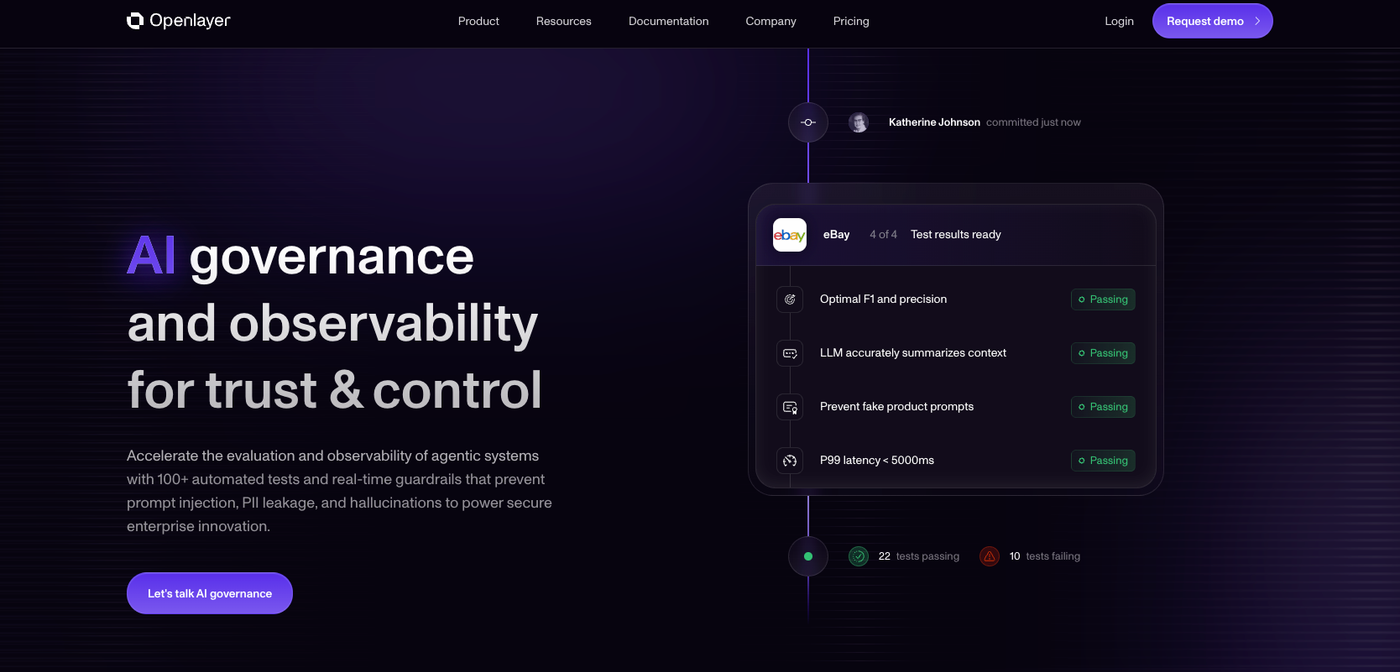
Openlayer covers automated testing, real-time security guardrails, and continuous monitoring across ML, GenAI, and agentic systems. We provide unified AI governance and compliance from development through production with automated compliance mapping.
Key strengths
Openlayer has a number of key strengths when comparing it to Braintrust as an AI evaluation and observability tool:
- 100+ prebuilt tests detecting hallucinations, bias, toxicity, PII leakage, prompt injection, drift, and robustness across text, vision, tabular, audio, and agent workflows
- Real-time guardrails preventing prompt injections and data exfiltration before reaching downstream systems
- Automated mapping to EU AI Act, NIST RMF, ISO 42001, OWASP, and LGPD with continuous risk assessment
- Continuous monitoring with anomaly detection, risk scoring, and policy-based alerts
The bottom line?
Openlayer is best for regulated enterprises in financial services, healthcare, telecom, and utilities requiring governance, security, and testing.
Langsmith
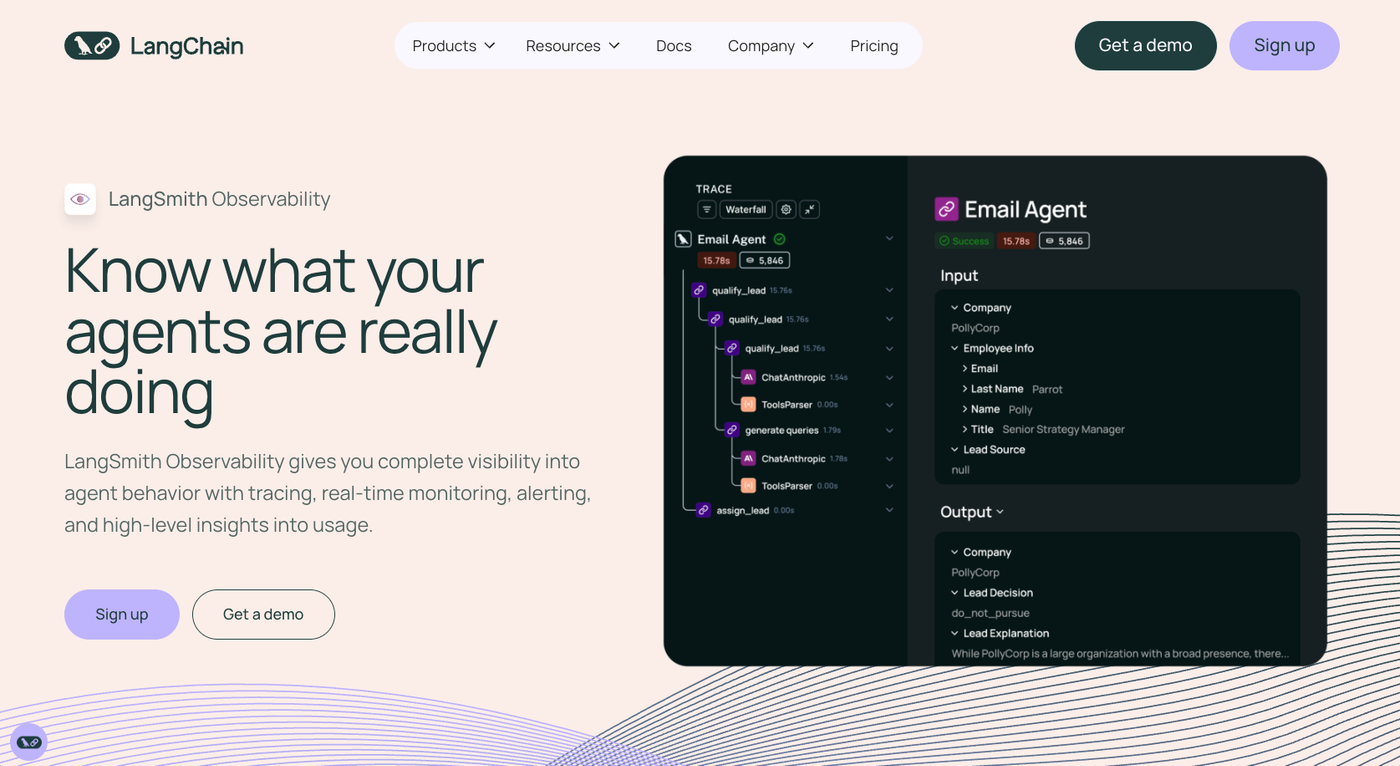
Langsmith offers developer-focused observability for LangChain applications with detailed tracing, dataset evaluation, and production monitoring.
Key strengths
Langsmith has a number of key strengths when comparing it to Braintrust as an AI evaluation and observability tool:
- Tracing for prompts, model calls, and agent steps
- Cost tracking and latency monitoring
- Dataset-based evaluations with custom metrics
- Production monitoring with alerts
The bottom line?
Langsmith doesn't have any real-time security guardrails, prebuilt test libraries, compliance mapping, or drift detection. All safety metrics require manual definition.
Langfuse

Langfuse is an open-source observability tool with tracing, prompt management, and evaluation capabilities supporting self-hosting.
Key strengths
Langfuse has a number of key strengths when comparing it to Braintrust as an AI evaluation and observability tool:
- Tracing for AI calls and tool usage
- Dataset experiments and custom evaluators
- Open-source with self-hosting options
The bottom line?
Langfuse doesn't include any prebuilt tests, native runtime guardrails, drift detection, or compliance framework mapping. Security relies on third-party integrations.
Deepchecks
Deepchecks provides pre-deployment evaluation suites and ML monitoring focused on structured testing before launch.
Key strengths
Deepchecks has a number of key strengths when comparing it to Braintrust as an AI evaluation and observability tool:
- Pre-deployment test suites for ML and AI
- Data quality checks and validation
The bottom line?
Deepchecks doesn't have any real-time security guardrails, continuous production monitoring, or compliance alignment to regulatory frameworks.
MLflow
MLflow handles experiment tracking, model registry, and lineage for ML operations.
Key strengths
MLflow has a number of key strengths when comparing it to Braintrust as an AI evaluation and observability tool:
- Experiment tracking for runs and parameters
- Model registry and versioning
The bottom line?
MLflow doesn't have any behavioral test libraries, runtime security protection, anomaly detection, or regulatory compliance mapping.
Feature comparison: Braintrust vs top alternatives
| Feature | Braintrust | Openlayer | LangSmith | Langfuse | Deepchecks | MLflow |
|---|---|---|---|---|---|---|
| Prebuilt test library | Partial | Yes | Partial | Partial | Yes | No |
| Real-time security guardrails | No | Yes | No (native) | Partial | Partial | No |
| Continuous monitoring | Yes | Yes | Yes | Yes | Yes | Partial |
| Compliance mapping | No | Yes | No | No | No | Partial |
| Multimodal support | Partial | Partial/Yes | Partial | Partial | Yes | Yes |
| CI/CD integration | Partial | Yes | Yes | Yes | Yes | Yes |
| Governance features | Partial | Yes | Partial | Partial | Partial | Yes (enterprise) |
| Runtime blocking | No | Yes | Partial | No | No | No |
Braintrust handles prompt testing and evaluation workflows but lacks runtime security, compliance tooling, and governance capabilities needed for regulated production deployments.
Braintrust pricing in December 2025
Braintrust uses a freemium model with three tiers:
- Free Tier. This includes 1 million trace spans, 1 GB of processed data, 10,000 scores per month, and 14-day data retention. Unlimited users are supported at no cost.
- Pro Plan. This is $249 per month and removes trace limits while expanding to 5 GB of processed data and 50,000 scores monthly. Data retention extends to 30 days.
- Enterprise pricing. This is custom and requires contacting sales. This tier supports organizations needing dedicated infrastructure, on-premise deployment, or higher usage thresholds.
Costs scale with usage. Exceeding limits on traces, processed data, or scores requires an upgrade or custom pricing arrangement.
Why Openlayer is the best Braintrust alternative
Braintrust handles development-stage evaluation with flexible scoring frameworks and collaborative prompt testing. Teams iterating on prompts benefit from its dataset management and version control.
Openlayer, on the other hand, extends beyond evaluation into operational governance. Real-time guardrails block prompt injection and PII leakage before execution, preventing security incidents rather than logging them. Our 100+ prebuilt tests validate hallucinations, bias, toxicity, and adversarial robustness across text, vision, audio, and tabular modalities without custom implementation. Continuous monitoring detects drift and anomalies in production with automated alerting. Automated compliance mapping to EU AI Act, NIST RMF, ISO 42001, and OWASP generates audit-ready evidence without manual documentation.
Organizations deploying AI in regulated industries choose Openlayer when they need unified governance from development through production. If your requirements include runtime security enforcement, automated compliance, or multimodal testing at enterprise scale, we deliver capabilities Braintrust wasn't designed to provide.
Final thoughts on AI evaluation and governance tools
Braintrust delivers solid prompt evaluation, but production deployments in regulated industries need more than traces and scores. When you're reviewing Braintrust alternatives, look for runtime blocking, compliance automation, and multimodal testing that match your actual requirements. Openlayer covers the full governance lifecycle, from prebuilt tests to audit-ready evidence. Choose the tool that fits where your AI systems are going, not where they are today.
FAQ
What's the main difference between Braintrust and Openlayer?
Braintrust focuses on prompt evaluation and dataset testing during development, while Openlayer provides end-to-end governance with real-time security guardrails, 100+ prebuilt tests across modalities, and automated compliance mapping to frameworks like EU AI Act and NIST RMF.
How do I know if I need real-time guardrails instead of just evaluation?
If your AI systems handle sensitive data, operate in regulated industries, or face security risks like prompt injection and PII leakage, you need runtime blocking that prevents incidents before they occur, not logging that records them after the fact.
Can I use Braintrust for production monitoring in regulated industries?
Braintrust provides basic trace collection but lacks continuous drift detection, anomaly alerting, automated compliance evidence, and runtime security enforcement required for regulated production deployments in financial services, healthcare, or telecom.
What does automated compliance mapping actually save me?
Automated mapping to regulatory frameworks eliminates manual documentation and legal reviews by continuously capturing model inventory, risk assessments, and audit evidence which replaces weeks of compliance work with audit-ready workflows that update in real time.
When should I consider switching from Braintrust to a governance platform?
Consider switching when you need multimodal testing beyond text, runtime security blocking, continuous production monitoring with drift detection, or automated compliance workflows, capabilities that evaluation-only tools weren't designed to provide.