Best AI observability tools for production monitoring (December 2025)
Everyone talks about deploying AI, but nobody warns you about what happens next. Your models start drifting, security teams flag prompt injection risks, and compliance requirements pile up faster than you can document them. Traditional monitoring tools weren't built for this. AI monitoring tools need to handle the unique ways AI systems break: non-deterministic outputs, data distribution shifts, and vulnerabilities that don't exist in regular software. We evaluated the platforms actively solving these challenges in production.
TLDR:
- AI observability tools monitor model performance, data quality, and security across development and production
- Real-time guardrails block prompt injection and PII leakage before reaching downstream systems
- Automated compliance mapping to EU AI Act, NIST RMF, and ISO 42001 reduces manual governance overhead
- Prebuilt tests in CI/CD pipelines catch regressions before deployment and monitor drift after release
- Openlayer unifies testing, monitoring, and compliance across ML, GenAI, and agentic systems
What are AI observability tools?
AI observability tools provide continuous monitoring, evaluation, and governance capabilities for AI systems throughout their lifecycle. These solutions track model performance, data quality, security threats, and compliance requirements across development and production environments.
Unlike traditional application monitoring, AI observability handles unique challenges inherent to AI systems:
- Non-deterministic outputs mean the same input can produce different results
- Model drift occurs when real-world data distributions shift over time
- Bias can arise from training data or model decisions
- Prompt injection vulnerabilities expose LLMs to malicious manipulation.
The category has grown rapidly as AI deployments scale. 75% of organizations increased their observability budgets in 2024. The shift reflects a simple reality: you can't fix what you can't see, and AI systems fail differently than traditional software.
How we ranked AI observability tools
We looked at each tool against criteria that matter for production deployments:
- Real-time monitoring. These capabilities determine how quickly you detect issues.
- Security. We looked at how the solution enacted guardrails protect against prompt injection and PII leakage.
- Testing automation. This reduces manual validation overhead.
- Integration flexibility. This matters because these tools must fit your existing stack.
- Multi-modal. We assessed support for multimodal systems (text, vision, tabular, audio) since most organizations deploy multiple AI types.
- Continuous evaluation. These capabilities separate tools that catch regressions early from those that only log metrics.
Enterprise governance requirements include role-based access, audit trails, and risk scoring.
Best overall AI observability software: Openlayer
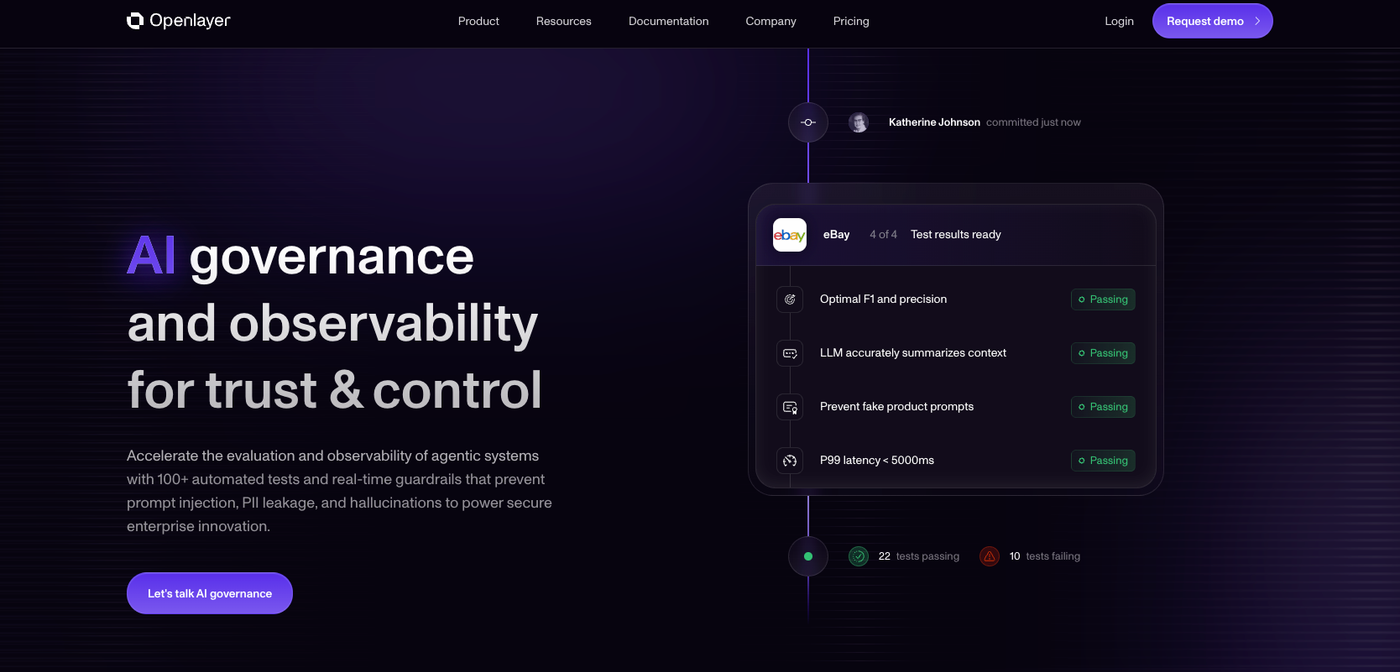
Openlayer unifies AI governance and observability across ML, GenAI, and agentic systems. The tool bridges development testing and production monitoring, which most competitors treat separately.
Evaluation-driven development
100+ prebuilt tests run in CI/CD pipelines during development, then execute continuously on live production data. This catches regressions before deployment and monitors for drift, bias, and accuracy degradation after release.
Real-time security guardrails
LLM guardrails block prompt injection attempts and prevent PII leakage before reaching downstream systems at runtime. Traditional monitoring tools detect these issues after they occur.
Automated compliance mapping
The system maps AI projects to EU AI Act, NIST RMF, ISO 42001, OWASP, and LGPD requirements. It continuously collects audit evidence and maintains risk scoring across all AI assets. Openlayer supports text, vision, tabular, audio, and multimodal systems across cloud, on-premises, and hybrid deployments with SOC 2 compliance.
Langsmith
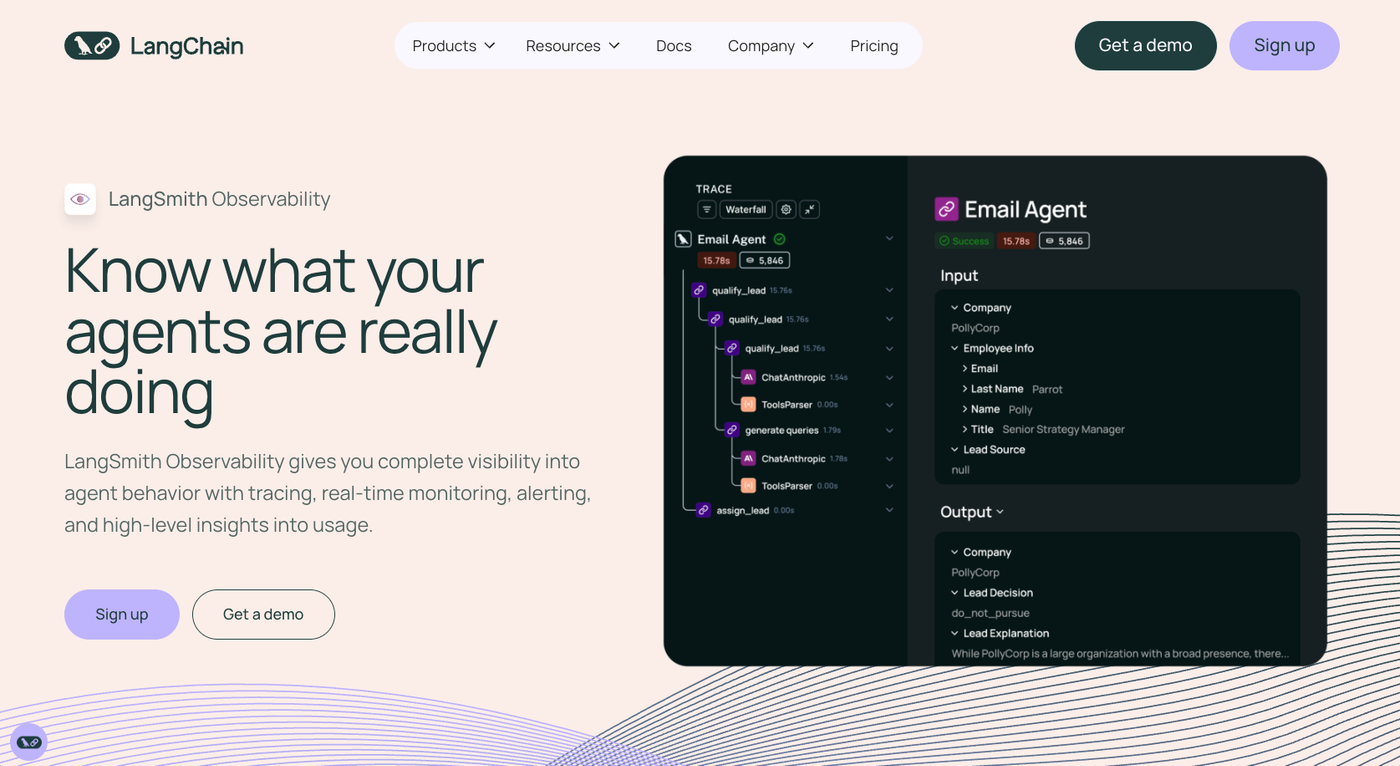
LangSmith provides evaluation capabilities supporting both automated and human-in-the-loop assessment. Teams can create evaluation datasets from production traces and define custom metrics using LLM-as-judge approaches.
Key features
LangSmith includes a number of AI observability features:
- Prompt-level evaluation and LLM application tracing with cost tracking and latency monitoring for model calls
- Version comparison and experiment management
- Integration with LangChain ecosystem
Good for teams already using LangChain who need basic observability within that specific framework.
The limitation: LangSmith lacks enterprise-wide oversight capabilities and does not provide statistical anomaly detection or compliance alerting. The evaluation framework requires manual setup of datasets and metrics rather than providing pre-built behavioral test suites for common AI risks.
Bottom line: LangSmith serves as a developer tool for LangChain applications but lacks the governance and security features needed for enterprise AI deployments.
Braintrust
Braintrust provides an evaluation framework built around datasets, tasks, and scorers. Teams need to manually implement most safety and quality metrics.
Key features
Braintrust includes a number of AI observability features:
- Evaluation gates in CI/CD workflows with regression detection
- Human and LLM-based feedback loops
- High-throughput trace analysis with purpose-built logging
- Dashboards and automated alerts for threshold violations
Limitations
Braintrust requires manual implementation of most behavioral tests and safety metrics. No prebuilt test library for common AI risks like bias, toxicity, or prompt injection. Alert systems require human intervention rather than real-time blocking.
The bottom line
Braintrust offers solid evaluation infrastructure but demands engineering investment to achieve enterprise-ready AI safety and governance. It is good for engineering teams who want to build custom evaluation workflows and have resources to implement safety metrics from scratch.
Langfuse

Langfuse is an open-source LLM engineering solution offering call tracking, tracing, prompt management, and evaluation capabilities. Teams can self-host to maintain control over data residency.
Key features
Langfuse includes a number of AI observability features:
- Detailed traces for prompts and model calls with cost tracking
- Open-source deployment with self-hosting capabilities
- Integration support for multiple LLM frameworks
Limitations
Langfuse provides observability and logging but does not natively enforce runtime policies or provide built-in behavioral test suites. Governance must be defined and enforced by external systems.
The bottom line
Langfuse delivers observability fundamentals but requires additional tooling to achieve AI governance and security. It is good for organizations requiring open-source solutions with self-hosting for data privacy compliance.
Arize AI

Arize AI monitors machine learning model performance and detects drift in production environments.
Key features
Arize AI includes a number of AI observability features:
- Drift detection that compares training data against production inputs to identify distribution changes that degrade model accuracy
- LLM evaluation with distributed tracing to track requests across multiple model calls and surface latency bottlenecks
- Performance analytics which connect model predictions with business outcomes like conversion rates or revenue impact
- OpenTelemetry integration for collecting traces from existing instrumentation
Limitation
Pricing scales quickly for high-volume deployments. Setup requires ML expertise to configure drift thresholds and evaluation metrics.
The bottom line
Best for ML teams running cloud-based models who need detailed drift analysis and have budget for specialized monitoring tools.
Fiddler AI
Fiddler AI focuses on model explainability and fairness analysis for production AI systems.
Key features
Fiddler AI includes a number of AI observability features:
- Explainability tools that surface feature importance and prediction reasoning for debugging model outputs
- Fairness analysis with bias detection across demographic groups and protected attributes
- Performance monitoring with drift detection for input distributions and accuracy degradation
- Cloud integrations with AWS, Azure, and GCP
Limitation
Narrow multimodal support. The interpretability focus adds computational overhead that slows inference for teams optimizing latency.
The bottom line
Best for regulated industries where explaining model decisions is required, less suited for teams managing diverse AI workloads at scale.
Feature comparison table of AI observability tools
| Feature | Openlayer | LangSmith | Braintrust | LangFuse | Arize AI | Fiddler AI |
|---|---|---|---|---|---|---|
| Multimodal testing | ✓ 100+ tests | ✓ | ✓ | Limited | Limited | Limited |
| Real-time security | ✓ Guardrails | Limited | Limited | Limited | Basic | ✓ Safety focus |
| Automated compliance | ✓ EU AI Act, NIST | Limited | Limited | Limited | Manual | Manual |
| CI/CD integration | ✓ Native | ✓ | ✓ | Limited | ✓ | Limited |
| On-premises deploy | ✓ Enterprise | ✓ | ✓ | ✓ | Limited | Limited |
| Cost transparency | Enterprise | Developer Pro, and Enterprise | Free, Pro, and Enterprise | OSS, hosted SaaS, Enterprise | High | Enterprise |
Why Openlayer is the best AI observability software
The AI observability market is growing rapidly, driven by increasing model complexity and regulatory pressures. Organizations need solutions that provide real-time insights while meeting compliance requirements.
Unfortunately, most teams juggle separate tools for development testing, production monitoring, and governance documentation. Openlayer unifies evaluation, observability, and compliance in one system that works across ML, GenAI, and agentic workflows.
When comparing AI observability tools, automation separates leaders from the rest. While competitors require manual compliance mapping and separate security layers, Openlayer embeds guardrails directly into runtime and automatically collects regulatory evidence.
And, for organizations deploying AI at scale, Openlayer provides the needed monitoring solution which can handle multimodal systems with enterprise security, without requiring multiple vendors or custom integrations. An AI governance platform provides the centralized control needed to manage these requirements.
FAQ
What's the difference between AI observability and traditional application monitoring?
AI observability handles non-deterministic outputs, model drift, and bias detection, challenges that don't exist in traditional software. While application monitoring tracks uptime and latency, AI observability looks at prediction quality, data distribution shifts, and security vulnerabilities like prompt injection across development and production environments.
How quickly can AI observability tools detect production issues?
Real-time guardrails can detect and block threats like prompt injection or PII leakage in under 300ms. For performance degradation and drift, detection speed depends on your monitoring configuration. Some teams can catch critical issues within hours instead of the weeks it takes with manual review processes.
When should I implement AI observability for my models?
Start before production deployment by integrating tests into your CI/CD pipeline. This catches regressions during development and creates baseline metrics for production monitoring. Teams that wait until after deployment spend way more time debugging issues that could have been prevented.
Can AI observability tools work with both traditional ML and LLM systems?
Yes, but capabilities vary by vendor. Some tools focus exclusively on either ML monitoring or LLM evaluation, requiring multiple solutions. Model-agnostic platforms support text, vision, tabular, audio, and multimodal systems under one roof, reducing integration complexity for teams running diverse AI workloads.
What compliance frameworks do AI observability platforms support?
Leading platforms automatically map projects to EU AI Act, NIST RMF, ISO 42001, OWASP, and LGPD requirements. This automation replaces manual compliance mapping and continuously collects audit evidence, which is critical for regulated industries like financial services, healthcare, and telecommunications.
Final thoughts on AI monitoring and observability
AI observability software should reduce complexity, not add another layer of tooling to manage across your development and production environments. You need automated testing, real-time security, and compliance reporting that works across ML and GenAI systems. The tools that win are the ones that let your team focus on building better AI instead of babysitting monitoring dashboards.