> ## Documentation Index
> Fetch the complete documentation index at: https://openlayer.com/docs/llms.txt
> Use this file to discover all available pages before exploring further.
# Overview
> Route your LLM traffic through one endpoint to get spend controls, key management, guardrails, and observability, without changing your app code
The **Openlayer Gateway** is a single endpoint that sits between your apps and your LLM providers
and **enforces your rules on every request, in real time**. It blocks calls that go over budget,
stops prompt injection, and redacts PII before a request reaches a provider or a response reaches a
user.
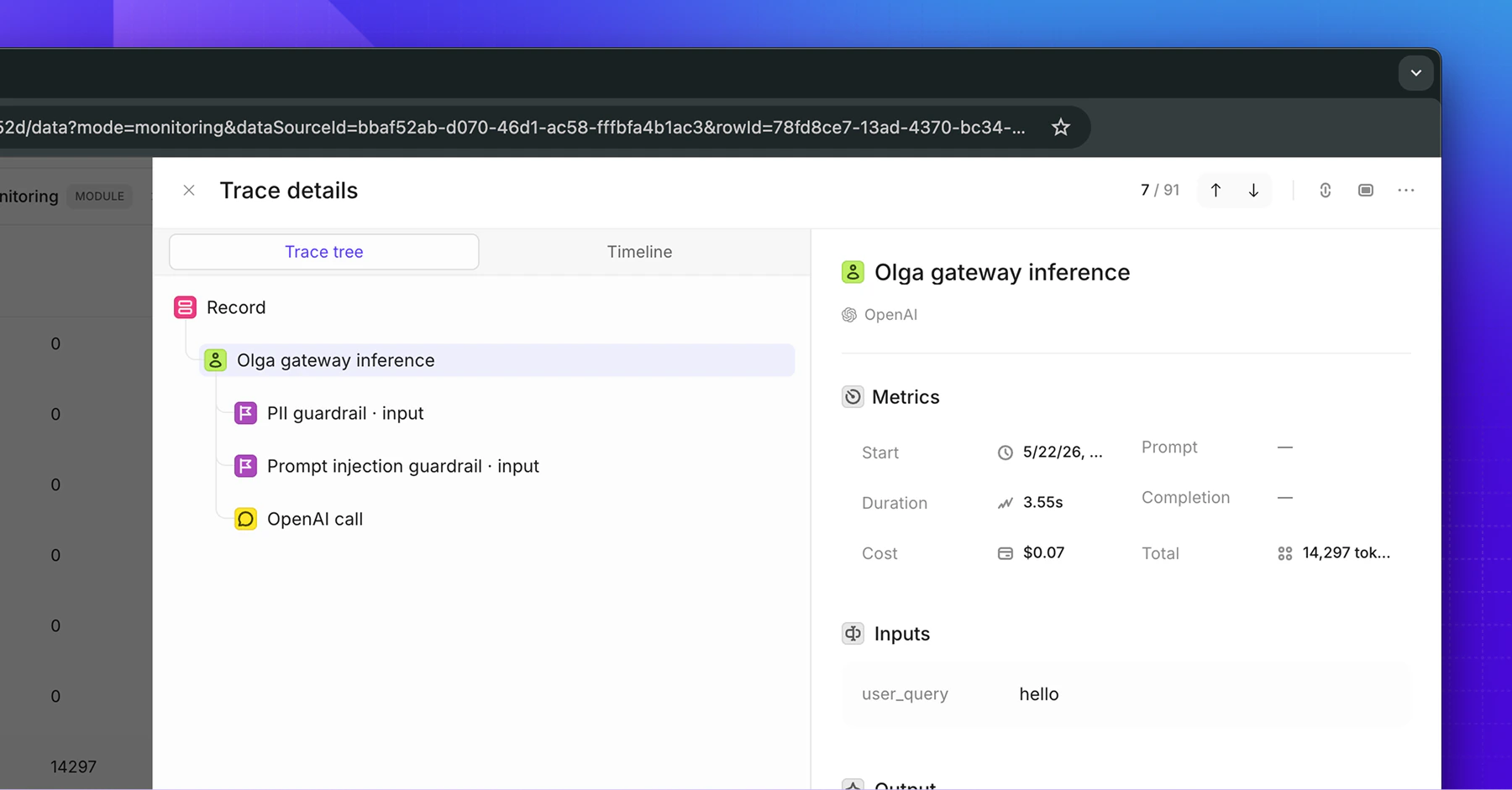
Every request that flows through the gateway is also [traced to your Openlayer project](/gateway/observability), so
the monitoring you already rely on keeps working.
## How it works
Keep your existing OpenAI- or Anthropic-compatible client. Point its base URL at the gateway
and swap in a gateway key.
For example:
```python theme={null}
from openai import OpenAI
client = OpenAI(
base_url="https://your-gateway.example.com/v1", # the gateway, not api.openai.com
api_key="sk-olga-...", # a gateway key, not your provider key
)
response = client.responses.create(model="gpt-4o-mini", input="Hello!")
```
The gateway verifies the key, runs your [content guardrails](/gateway/guardrails), and checks the request against
your [usage limits](/gateway/usage-and-cost). Anything that trips a guardrail or exceeds a limit is blocked here, before it
reaches a provider.
It forwards the request to the provider you configured, and can override the model or
**translate between formats**, so an OpenAI-style request runs against an Anthropic model, and
vice versa.
[Output guardrails](/gateway/guardrails) run on the way back, then the response streams to your app. Every request
is also published as a [trace](/gateway/observability) in your Openlayer project, fire-and-forget, so tracing never
slows or breaks a response.
 ## What you get
Everything is configured once, in the gateway's admin portal. There are no redeploys and no code
changes in the apps sending traffic.
## What you get
Everything is configured once, in the gateway's admin portal. There are no redeploys and no code
changes in the apps sending traffic.
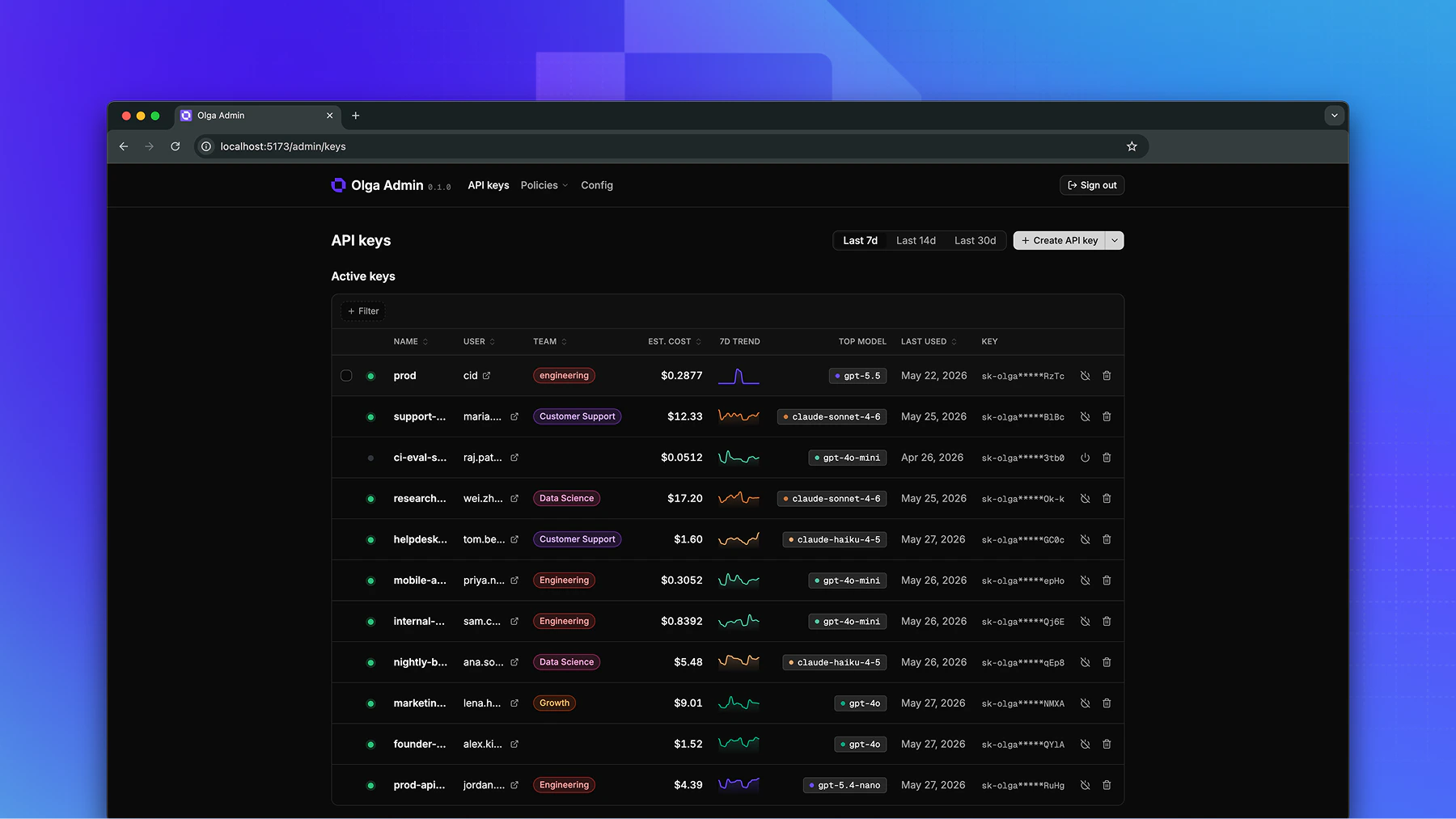 Issue and revoke keys for each app or teammate, group them into teams, and
hand out self-serve invite links.
Cap spend, requests, or tokens per key or team, and see exactly what's being
consumed and what it costs.
Block or redact PII and stop prompt-injection attempts on inputs and
outputs, before they reach a provider or a user.
Connect OpenAI, Anthropic, and Azure upstreams, route traffic between them,
and call any model from any SDK.
## FAQ
Almost nothing. You point your client at the gateway's base URL and use a gateway key instead of
a provider key. That's it. Any client that speaks the **OpenAI Responses API** or the
**Anthropic Messages API** works unchanged, including streaming.
They serve different jobs and you can use either or both.
The **gateway** exists to enforce your rules on every request, in real time. Tracing comes as a
byproduct: because traffic flows through the gateway, every request is also
[published to your Openlayer project](/gateway/observability) without any SDK in your apps. That
makes it the right path when you want governance plus baseline observability across many apps or
languages at one chokepoint.
The **[Openlayer SDK](/monitoring/instrument)** runs inside your code. It doesn't enforce anything
at the request boundary, but it captures detail the gateway can't see from outside: nested spans
for retrieval, tools, and sub-calls in a multi-step pipeline, plus any custom metadata. Reach for
it when you need fine-grained traces of how a feature actually runs.
A common setup is the gateway for governance and baseline traces, plus the SDK in the places that
need the deeper view.
The gateway forwards traffic. It doesn't keep your prompts and responses. It stores hashed API
keys, per-day usage tallies, and guardrail event metadata (which guardrail triggered and what
kind of entity, not the underlying text).
The full request and response content is sent to **your Openlayer project** as a trace, where
your data-retention and access controls apply. Openlayer can run on-premises or as
SOC 2 Type II compliant SaaS.
Yes. When you route a request to a provider whose format differs from your client's, the gateway
translates the request, response, and stream between the OpenAI Responses API and the Anthropic
Messages API. See [Use any model from any SDK](/gateway/use-any-model).
OpenAI, Anthropic, and Azure OpenAI / Foundry today. Any provider that exposes an
OpenAI- or Anthropic-compatible API can be connected. See
[Connect providers](/gateway/connect-providers).
Issue and revoke keys for each app or teammate, group them into teams, and
hand out self-serve invite links.
Cap spend, requests, or tokens per key or team, and see exactly what's being
consumed and what it costs.
Block or redact PII and stop prompt-injection attempts on inputs and
outputs, before they reach a provider or a user.
Connect OpenAI, Anthropic, and Azure upstreams, route traffic between them,
and call any model from any SDK.
## FAQ
Almost nothing. You point your client at the gateway's base URL and use a gateway key instead of
a provider key. That's it. Any client that speaks the **OpenAI Responses API** or the
**Anthropic Messages API** works unchanged, including streaming.
They serve different jobs and you can use either or both.
The **gateway** exists to enforce your rules on every request, in real time. Tracing comes as a
byproduct: because traffic flows through the gateway, every request is also
[published to your Openlayer project](/gateway/observability) without any SDK in your apps. That
makes it the right path when you want governance plus baseline observability across many apps or
languages at one chokepoint.
The **[Openlayer SDK](/monitoring/instrument)** runs inside your code. It doesn't enforce anything
at the request boundary, but it captures detail the gateway can't see from outside: nested spans
for retrieval, tools, and sub-calls in a multi-step pipeline, plus any custom metadata. Reach for
it when you need fine-grained traces of how a feature actually runs.
A common setup is the gateway for governance and baseline traces, plus the SDK in the places that
need the deeper view.
The gateway forwards traffic. It doesn't keep your prompts and responses. It stores hashed API
keys, per-day usage tallies, and guardrail event metadata (which guardrail triggered and what
kind of entity, not the underlying text).
The full request and response content is sent to **your Openlayer project** as a trace, where
your data-retention and access controls apply. Openlayer can run on-premises or as
SOC 2 Type II compliant SaaS.
Yes. When you route a request to a provider whose format differs from your client's, the gateway
translates the request, response, and stream between the OpenAI Responses API and the Anthropic
Messages API. See [Use any model from any SDK](/gateway/use-any-model).
OpenAI, Anthropic, and Azure OpenAI / Foundry today. Any provider that exposes an
OpenAI- or Anthropic-compatible API can be connected. See
[Connect providers](/gateway/connect-providers).